Transform Your IT Costs Into a Business Growth Engine
IT audit focused on profit
Where Your Business Loses Money
Infrastructure Slows Growth
What was okay for the first 10 clients is unacceptable when scaling to 100. Each expansion becomes a complex technical challenge.
Services regularly crash. The team spends time solving problems that could have been prevented.
When investments double, the number of clients served increases by only 10%.
Hundreds of servers, services, subscriptions, databases. Are you sure you need all of them? And that they should cost exactly this much?
Team Gains Experience Slowly
A task takes a week instead of a few hours. People don't know simple and fast approaches - simply because no one showed them.
Inefficient processes became the norm, blind spots developed. "That's how it's done here." The team wastes time on routines that could be automated or simplified.
Subtle but significant nuances that are learned either through long experience or when someone shows "this is the right way".
While infrastructure stalls and the team works blindly - you lose profit and spend time on operations instead of business development.
Let's find out what's happening with your setup?
How We Return Money to You and Your Business
Cut costs without losing quality
We find inefficient spending and show how to redirect budget to growth instead of patching holes
Make the system predictable
Eliminate vulnerabilities before they turn into downtime and customer loss
Prepare infrastructure for scaling
Create a system that grows with your business rather than slowing it down
Free up owner's time
The team gets knowledge and tools to work independently - you focus on strategy
How We Work
Initial Consultation
We get acquainted, discuss tasks and determine compatibility. Discuss prospects for cost reduction.
Diagnostics
IT checkup: inventory, identifying questionable expenses, what to fix. Guidelines with cost estimates for execution.
Detailed Plan
Based on diagnostics, we create a detailed optimization plan. Price is formed from the volume of work on identified problems.
Implementation Options
Independent: plan + explanations
Consulting: weekly calls
Full implementation: we do it for you
Real Cases: How We Save Client Money
Case 1: AWS Audit - Found $3,787 in Monthly Leaks
Problem
The company was paying $21,000/month for AWS. Everything worked stably, but the owner felt they were paying too much. Requested an inventory audit.
What We Found (EC2 service only)
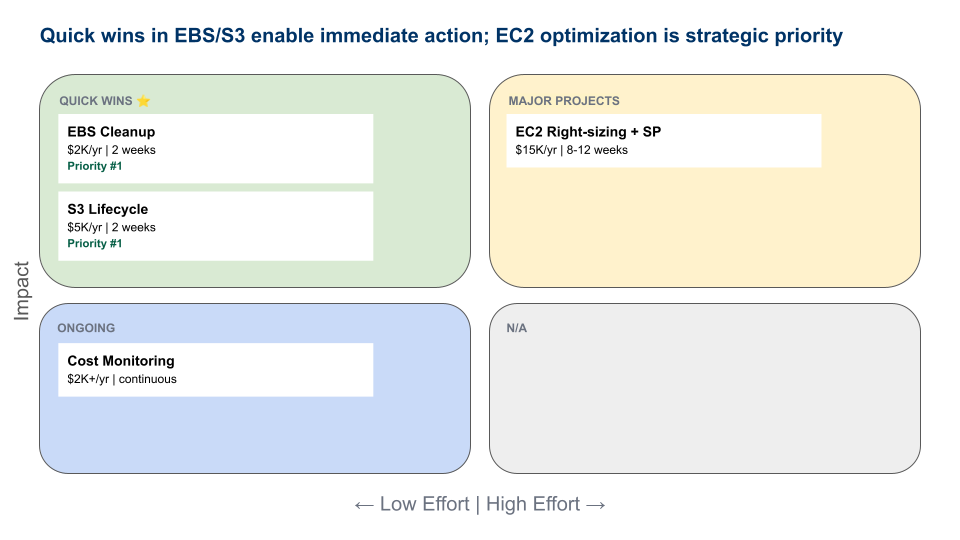
- $960/month - old snapshots unused for years
- $329/month - 3 oversized servers (running at 15% utilization)
- $720/year - 13 unused Reserved Instances
- $1,500/month - servers on On-Demand instead of Savings Plan
- $34/month - stopped instances (still paying for disks)
- $244/month - unused EBS volumes
And this is only EC2! Not counting Network, Load Balancers, Gateways, Lambda...
Result
Savings of $3,787/month or $45,444/year - 18% of infrastructure budget.
Funds were redirected to product development.
Case 2: E-commerce - Prevented Black Friday Crash
Problem
An online store was preparing for Black Friday and a massive advertising campaign. They forecasted 5-10x traffic growth. The system worked stably under normal load, but the owner worried - would it handle the peak?
What We Found
- Database - single point of failure, no read replicas
- Caching - configured only for the homepage, product pages hit the database every time
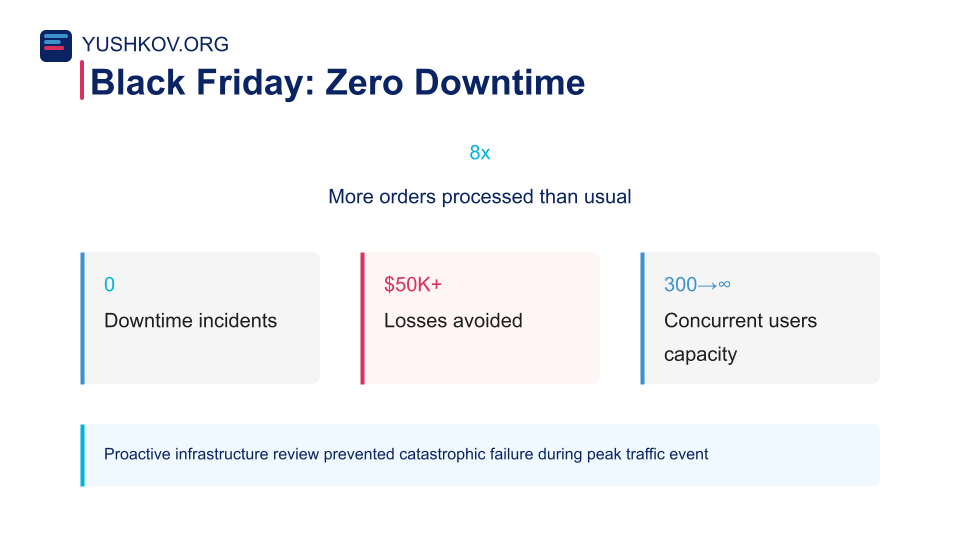
- Servers - only 2 instances, wouldn't handle more than 300 concurrent users
- Payment gateway - 30-second timeouts would create a queue during peak
- Monitoring - alerts only for crashes, no warnings about load increases
- Autoscaling - absent
- DDoS protection - absent
What We Did
- Deployed database read replicas
- Configured multi-level caching (Redis + CDN)
- Set up autoscaling with limits and budget alerts
- Connected AWS WAF for DDoS protection
- Optimized timeouts and added retry logic
- Configured predictive alerts for load and costs
- Optimized application architecture
Result
Black Friday passed without a single failure. Processed 8x more orders than usual.
Avoided: at least $50,000 in losses from downtime + reputational damage.
Case 3: Kubernetes on OVH - Cut Costs in Half
Problem
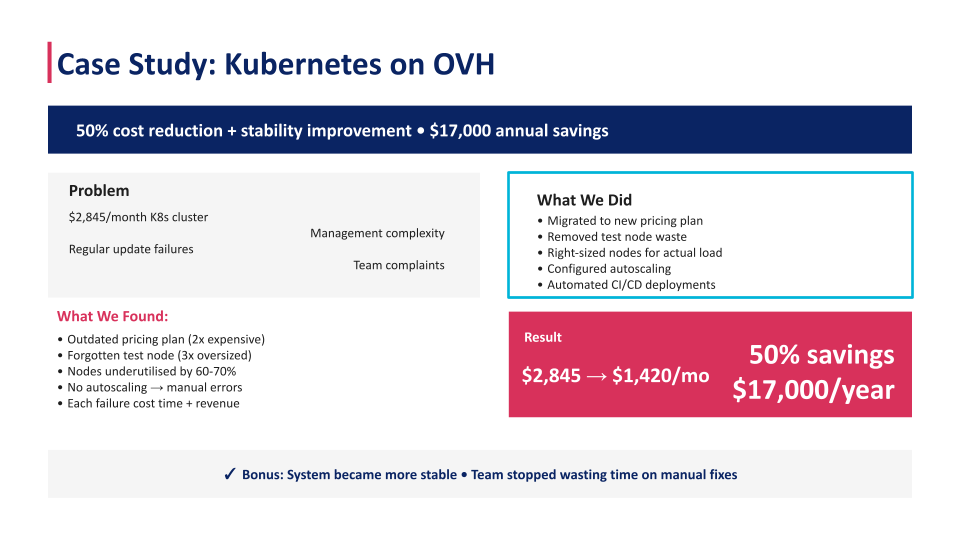
The company was paying $2,845/month for a K8s cluster on OVH. The system worked, but the team complained about management complexity and regular issues during updates.
What We Found
- Outdated pricing plan - 2x more expensive than the new plan for the same capacity
- Forgotten test node - 3x more powerful than standard nodes, running for months
- Oversized nodes - resources underutilized by 60-70%
- No autoscaling - manual manifest changes led to errors and downtime
- Expensive fixes - each failure cost team time and lost revenue
What We Did
- Migrated to new pricing plan
- Removed test node
- Optimized node sizes for actual load
- Configured autoscaling
- Automated deployments via CI/CD
Result
$2,845 → $1,420/month - 50% savings or $17,000/year
Bonus: the system became more stable, the team stopped wasting time on manual edits and error fixes.
Case 4: Multi-Account AWS - From Chaos to Control
Problem
5 AWS accounts (1 isolated + 4 with consolidated billing), ~$5,000/month. CFO demanded cost transparency, but CTO couldn't explain the structure - there was no documentation.
Critical: ~500 IAM users, of which 300 inactive for 3+ years (record: 12 years). Active credentials = active attack surface.
What We Found
- 26 idle Elastic IPs - $93/month
- 3 forgotten Lightsail instances - $73/month
- Old EBS snapshots + volumes - $32/month
- RDS backup cleanup - $15/month
- 6 inactive Data Pipelines - $6/month
- S3: used free Storage Lens, removed duplicates and obsolete data (20% reduction) - $300/month
What We Did
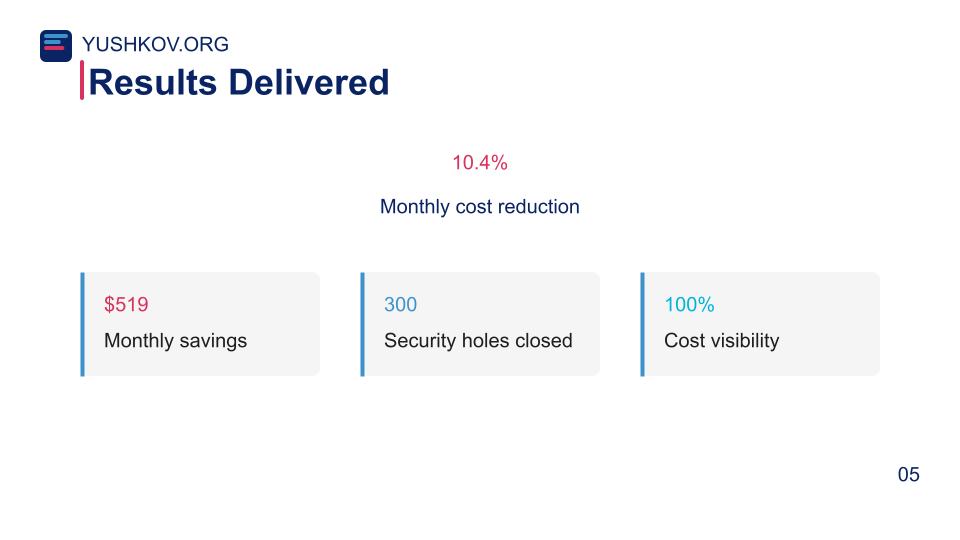
- Deleted 300 inactive IAM users (closed security hole)
- Conducted full inventory of all 5 accounts
- Implemented all quick wins in 3 weeks
- Created unified cost dashboard with breakdown by accounts
- Recommended AWS Organizations for governance
Result
$519/month savings (10.4% cost reduction) or $6,228/year
CTO: clarity on infrastructure
CFO: full cost transparency
Security: 300 vulnerabilities eliminated
How much money is leaking from your infrastructure right now?
Let's find out in the first free consultation.
About the Expert
My name is Anton Yushkov, and I've been designing and maintaining IT infrastructure for over 15 years.
I've worked with different companies - from startups to large enterprises: Genesys, Digital Ocean, Cloudways. Many employees, many clients, high loads, clouds, DevOps, monitoring - the whole zoo.
You know what? In recent years, more and more people come with the request: "Everything works, but why is it so expensive?"
Honestly, I didn't understand at first. It works! Reliable, secure, scalable. What else do you need?
Then it hit me - the problem isn't that the infrastructure is bad. The problem is that it's built "right from an IT perspective" but not "right from a business perspective".
We IT folks love "just in case," "to be more reliable," "this thing is cool." But for business, that's... well, money down the drain.
It turns out that even technically correct infrastructure can be dramatically improved by understanding the specifics of a particular business. What's truly critical, and where you can optimize without losing quality.
And the result is simple - money stops burning for nothing, the system works more stably, and freed-up resources go to business development. Everyone's happy.
That's what I do now - I help companies make their IT not just working, but working for profit.
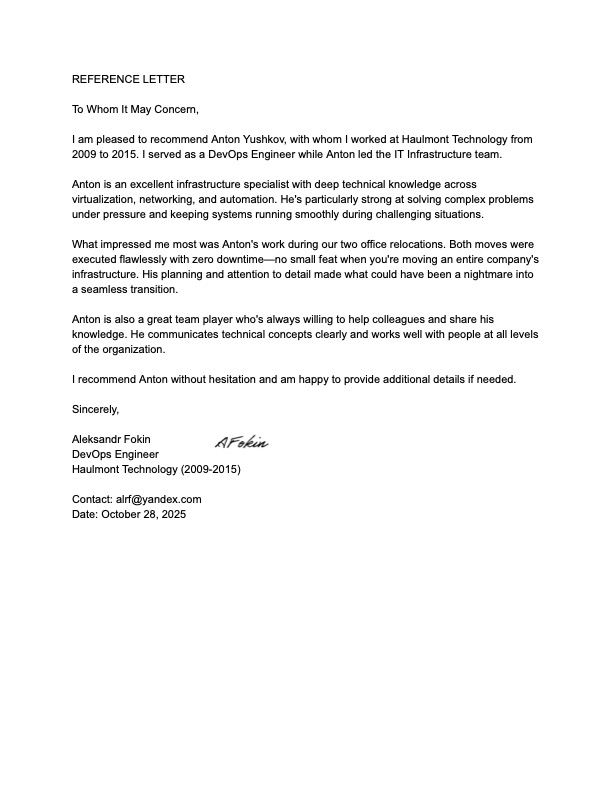
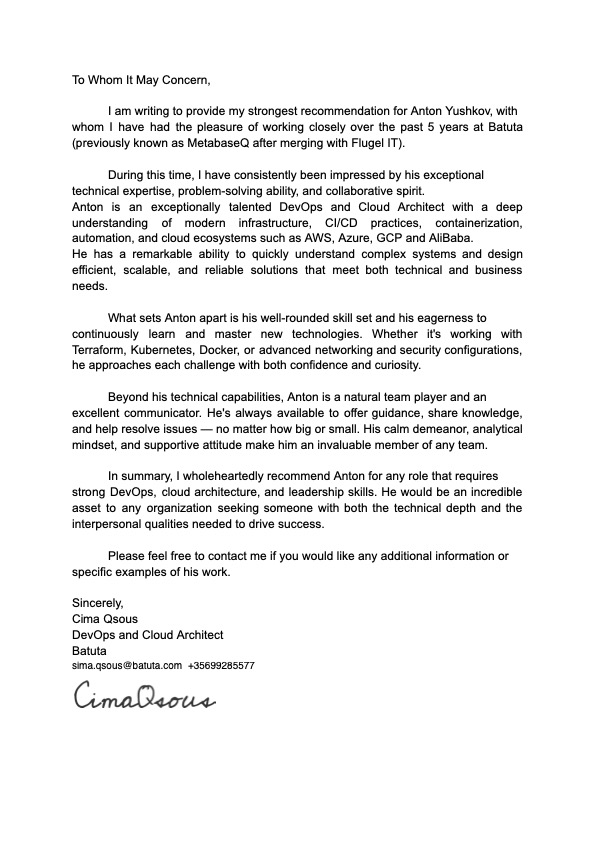
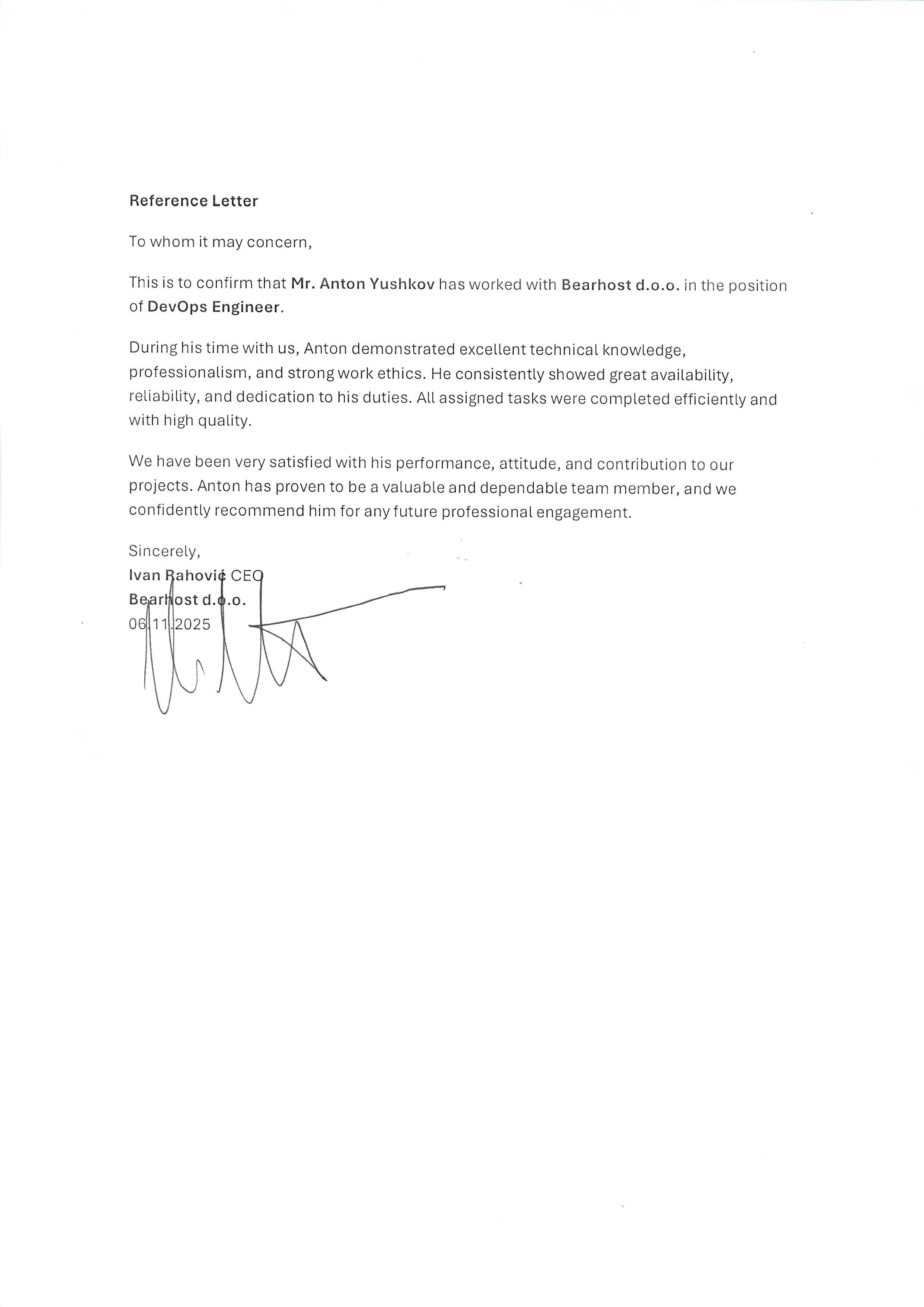
Reviews & Reference Letters
Frequently Asked Questions
What if the audit doesn't find any problems?
There are no healthy people, only under-examined ones. But even if you have perfect infrastructure - knowing that for certain - that's peace of mind and confidence in your business.
How quickly will the audit pay for itself?
Statistics show the audit pays for itself in 1-3 months - depending on your situation.
In fact, the audit is free for you. Yes, I'll charge, but it will pay back in at most three months. The audit pays for itself.
Do the math yourself: up to 42% of IT resources are wasted. Even if you save just 20% of your monthly expenses - how much is that per year? Over three years?
Money saved = money earned. You can invest these funds in development and earn even more.
How long will it take?
Initial diagnostics takes one week. We study your infrastructure, communicate, ask what and why, prepare a report and action plan. Based on the report and plan, we work with you to create further specifications with specific timelines, depending on your unique business.
What level of access do you need?
Read-only/audit access. This is important - we don't interfere with your infrastructure at the initial stage. We only look and ask questions.
Won't the system operation be disrupted?
Even read-only access can overload your resources. That's why we work extremely carefully and first determine your resources and specifics.
What guarantees do you provide?
We use all our experience and knowledge to make your infrastructure more reliable and cost-effective. Specific guarantees are discussed individually depending on the project.
Start with the First Meeting
30 minutes of discussion - and you'll understand whether you need an IT audit and what it can give your business